The Zoöp
One of the most distinctive aspects of Bauhaus of the Seas Sails was its insistence that communities are not made up of humans alone. The coastlines, estuaries, lagoons and rivers that the project engaged with are considered shared environments, inhabited not just by people but also by fish, birds, plants, microorganisms and countless other species whose interests are rarely represented in the decisions that shape their habitats. We took seriously the question of how those interests might be included.
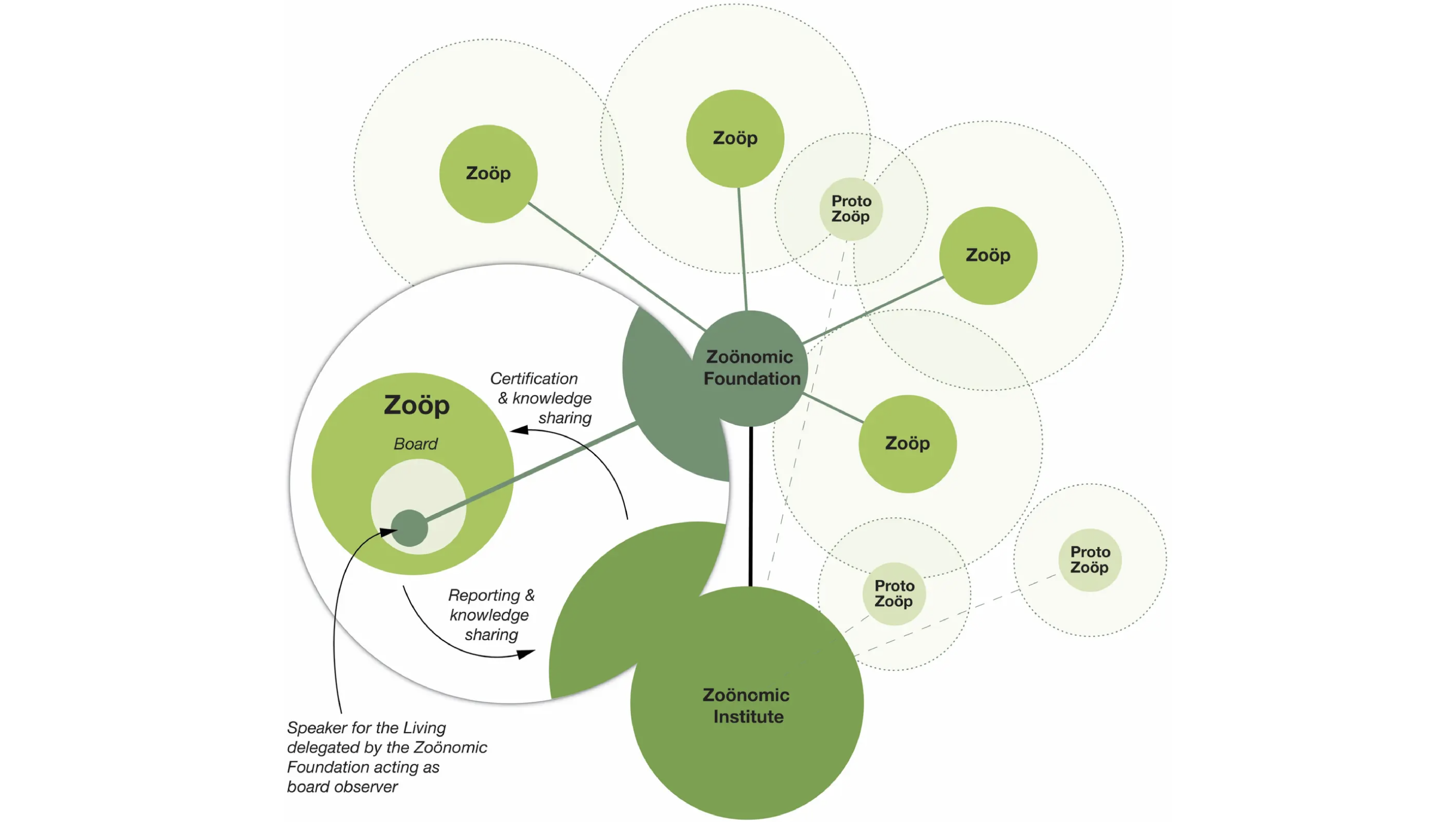
As such, the project adopted the Zoöp, an organisational model championed by Klaas Kuitenbrouwer at the Nieuwe Instituut in Rotterdam, which formally integrates non-human interests into institutional decision-making. In each pilot location, a pilot-Zoöp was established: a locally adapted version of the model, shaped by the specific ecology and institutional context of each place. The Zoöp works through a structured annual cycle of observation, characterisation and intervention – a process of learning to understand what an ecosystem needs before deciding how to act within it.
Central to each Zoöp is the Speaker for the Living, an individual formally designated to represent – in Sea Forums, workshops and project activities – the interests of non-human beings that are part of each ecosystem. Speakers for the Living were active in all seven locations, ensuring that ecological perspectives were present not just as data points, but as participants in the conversation.
The Zoöp is not a metaphor, it is a working governance model, now being adapted and tested in contexts beyond Bauhaus of the Seas Sails. In Malmö, it has been formalised through institutional agreements. In Rotterdam, it builds on a Zoöp that already existed at the Nieuwe Instituut. Across the project, it provided a shared framework for thinking beyond sustainability and to act regeneratively, that is, in a way that actively supports the health and diversity of our shared, aquatic ecosystems.
Working across generations and cultures
Bauhaus of the Seas Sails was deliberately intergenerational and intercultural. The challenges facing coastal cities — climate change, ecological loss, social inequality, cultural erosion — affect different generations in different ways, and are experienced through very different cultural lenses depending on who you are and where you come from. Designing for coastal futures means little if it only involves those who are already comfortable inside cultural institutions, already fluent in the language of sustainability, already represented. From the outset, the project set itself the harder task of reaching across these divides.
This was built into the structure. Sea Forums and Ocean Ambassadors were established in every pilot city specifically to bring in perspectives that wouldn't otherwise reach the table — from senior citizens who remember what the water looked like before, to teenagers growing up with a sea they've been told is disappearing, to migrants and communities of different backgrounds for whom the relationship to a European coastline carries its own particular weight. What follows are some of the ways this commitment played out across the seven pilots.
Seniors and students, side by side
In Venice, the Blue Seniors drop made intergenerational encounter the engine of the entire design process. Ca' Foscari University students were not simply designing for older people: they were designing with them, informed by them, and judged by them. Over 100 interviews with elderly Venetians — conducted by students and then synthesised into nine key themes — shaped every prototype that followed. The resulting 27 digital platform proposals were then evaluated directly by 200 senior citizens in hands-on sessions, giving older residents genuine agency over what would and wouldn't work. The process created something rarer than a good design outcome: it created a genuine encounter between two generations of Venetians who might otherwise never have shared a room, let alone a conversation about mobility, heritage, and what the lagoon means to them.
In Genoa, the Inclusive Digital Storytelling drop placed the memories and voices of elderly residents at the very centre of its methodology. Stories from older Vernazzola residents — of the local beach as a social space, of fishing practices that have largely disappeared, of a neighbourhood that once oriented its entire daily life towards the sea — became the raw material for the PAVIS AR app and the Tra il dire e il mare exhibition. The pilot found, as others did, that the strongest stories about how we should relate to coastal ecosystems are often held by people who remember an earlier relationship with them: more proximate, more dependent, more attentive to the signs of change.
In Hamburg, the Summer Course at the culinary school created a different kind of intergenerational encounter: one built around professional transmission. Fellows — experienced chefs holding Green Michelin Stars and regenerative food producers — led hands-on sessions for students from diverse backgrounds, passing on fermentation techniques, knowledge of dual-purpose chicken rearing, and an understanding of how the Elbe's ecology connects to what ends up on the plate. For the fellows, it was an opportunity to develop a new revenue stream and a new form of connection to the next generation of Hamburg's food scene. Several students reported a clear intention to take these techniques into their future kitchens. The fellowship programme has committed to continuing the course beyond the project, with ambitions to integrate it into the school's regular curriculum.
Children as participants, not passengers
Across several pilots, children were engaged not as recipients of educational content but as active participants in processes of making and discovery. In Lisbon, children from Escola Básica Luíza Neto Jorge took part in the Regenerative Menu project, cooking and tasting dishes built around ingredients from the Tagus estuary — herbs from the saltpans, fish from the river, flavours that most of them had never encountered despite living alongside the water their whole lives. At the other end of the material spectrum, bio-ceramic tile-making workshops in Marvila — one of Lisbon's most under-resourced neighbourhoods — brought children and local residents together around a process that connected centuries-old Portuguese craft with cutting-edge biomaterial research using oyster shells and seaweed. The workshop asked nothing exotic of participants: just their hands, their curiosity, and a willingness to make something together from what the estuary produces.
In Oeiras, children were among the participants at a bio-azulejo workshop in Nazaré, and families were engaged throughout the Ocean Literacy programming at the Aquário Vasco da Gama — an institution already embedded in the local imagination as a place of wonder about marine life, and now connected more explicitly to the question of what the Tagus estuary is, who it belongs to, and what it needs from us.
In Malmö, schoolchildren were reached directly through the Marine Education Centre, one of the pilot's key partner institutions, and were among those engaged across the two World Ocean Day celebrations at the South Wharf Basin. These events asked something of them that few public activities do: to be co-agents of an ecological process, not just observers of one. The reef they helped to build now hosts blue mussels, algae, and sea bristle worms. It grows and changes, and they had a part in that.
Students as designers of futures
University students played a significant role across the project — not as passive learners but as active contributors to real territorial debates. In the Delta, students from over 20 universities participated in the Next Generation Podium, developing scenarios for the future of Grenspark Groot Saeftinghe that have since entered conversations among decision-makers in the region. Their proposals — salt-resistant crops, climate-resilient architectures, hybrid land-use models that attempt to reconcile port, agriculture, and rewilded nature — are speculative in the best sense: they open possibilities that current planning frameworks have not yet imagined. For a territory that struggles to remain attractive to young people, this was also a statement about who belongs to the future of a place.
In Venice, architecture students worked intensively on the San Basilio and Santa Marta waterfront area in a week-long workshop that generated an "exhibition of ideas" feeding directly into ongoing planning discussions with the Port Authority. A small but concrete ripple followed: in February 2025, the Port Authority installed benches and a table-tennis table in the Santa Marta area — a modest act of tactical urbanism, but one that traced directly back to the students' momentum. In Oeiras, students were part of the audience for the sound installation Interferências no Tejo and the broader programme at CAM Gulbenkian, and the After Summer School in Rotterdam brought together graduate students and practitioners from multiple disciplines for a sustained period of learning, making, and reflecting together.
Reaching beyond the usual audiences
Every pilot contended with the same underlying challenge: cultural institutions, however well-intentioned, tend to attract the same audiences. The people who most need to be part of conversations about climate adaptation, ecological connection, and coastal futures are often precisely those least likely to walk through the doors of a museum, a university gallery, or a design hub.
The Ocean Ambassador programme was designed explicitly to create bridges across this gap. Ambassadors were not spokespersons for the project; they were connectors — people with roots in communities that the pilots wanted to reach, with the trust and relationships needed to make genuine engagement possible. Their profiles varied significantly across the seven pilots: artists, chefs, activists, educators, scientists, community organisers, people passionate about their local waterway. In Malmö, a city where nearly half the population is under 35 and 179 nationalities are represented, Ambassadors helped to connect the pilot's activities to communities of different cultural backgrounds for whom the New Harbour area represents very different things — a development that displaces, or a development that includes, depending on how it is shaped.
In Hamburg and Rotterdam, activities were specifically designed to reach people from disadvantaged socioeconomic backgrounds, including culinary students from working-class families and participants in community food activities. In Lisbon, Marvila — one of the city's most under-resourced districts — was a deliberate site of activity rather than an afterthought: tile-making workshops, food residencies, and the Mobile Kitchen co-developed with the Food from the Block collective were all grounded in that neighbourhood's specific people and conditions.
Not every pilot succeeded equally in this. Reaching beyond "the usual suspects" who visit cultural institutions proved consistently challenging, and the project's own impact assessment was candid about this. Dedicated activities for specific groups — a primary school class, a neighbourhood association, a fishing community — proved more effective than open public programming alone. This is worth naming not as a failure but as a finding: cultural projects working at this intersection of ecology, aesthetics, and inclusion need strategies that are as specific as the communities they are trying to reach.
More-than-human participants
Intergenerational and intercultural participation, in the BoS framework, extended beyond the human. The Zoöp methodology — developed by the Zoönomic Institute and deployed across all seven pilots — created formal structures for including the perspectives of local ecosystems in the co-design process. Speakers for the Living represented non-human interests in Sea Forum meetings: the eelgrass of Malmö's basin, the microbial life of the Tagus, the fish of the Elbe, the salt marsh communities of Grenspark Groot Saeftinghe.
This was not merely symbolic. In Malmö, the Speaker for the Living actively shaped decisions about the reef's design and placement. In Genoa, the local Speaker engaged the community in direct environmental observation — recording species sightings in the coastal area — and participants reported an increased sense of responsibility towards the marine environment as a result. In Oeiras, a Large Language Model was used in participatory sessions at the Aquário Vasco da Gama to facilitate biocentric decision-making, simulating the voice of the Tagus river in a governance process for the aquarium. These are early, imperfect experiments in a new mode of participation — but they are experiments, and they are being taken seriously.
The ambition underlying all of this is straightforward to state and difficult to achieve: that the people who will live with the consequences of decisions about coastal environments — including the non-human people — should have a genuine role in making them. Bauhaus of the Seas Sails did not solve this problem. It worked on it, across seven locations, across three years, with more than 2,500 citizens and an unknowable number of marine species. That feels like a beginning.